02 / LEGACYARTISTIC VISUALIZATION · NOT A PHYSICS SIMULATION
1908BORN IN ODESA
1929FIRST LABORATORY CHAPTER
1974NPO ENERGIA
1988ENERGIA–BURAN FLIGHT
PEOPLE WHO SHAPED SPACEFLIGHT
THE MIND BEHIND THE THRUST.
From a childhood in Odesa to the engines and institutions of the space age. An illustrated introduction to a complex engineering life.
Spaceflight is usually remembered through a rocket, a crew or a single dramatic image. Its quieter history lives in laboratories, design offices and years of shared work.
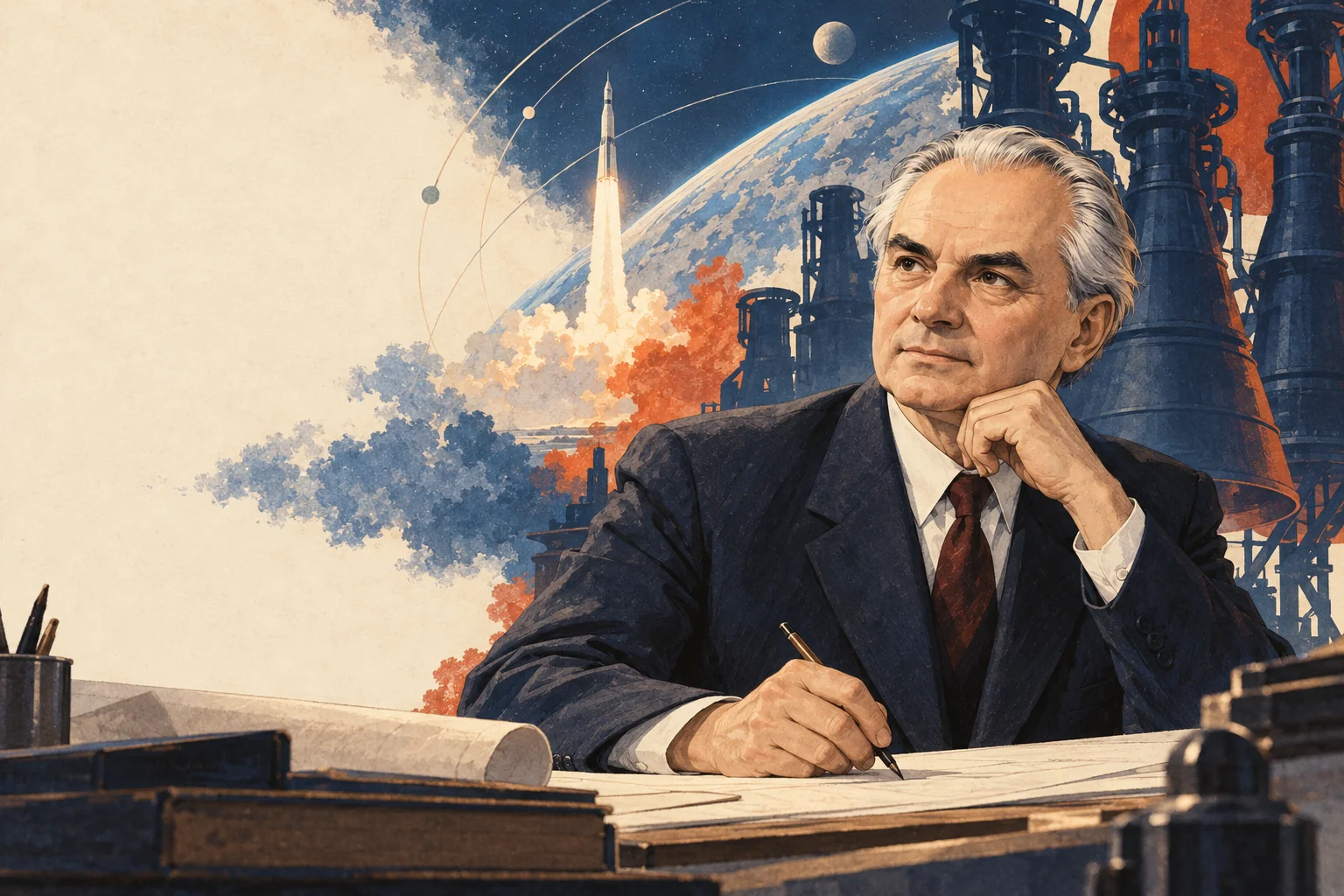
Artist’s interpretation of Valentin Glushko. Not an archival photograph.
EIGHT CHAPTERS / A LIFE IN ENGINEERING01 — 08
01
BEGINNINGS
A question bigger than the horizon
Glushko was born in Odesa in 1908. His early interest in space travel led him to correspond with Konstantin Tsiolkovsky while still a teenager. The letters belong to a time when journeys beyond Earth were largely an idea to be argued for.
The attraction of that beginning is not a story of instant certainty. It is the distance between asking whether something could exist and spending a working life on the practical questions that follow.
In 1929 he began work at the Gas Dynamics Laboratory in Leningrad. Electric propulsion and liquid-fuel rocket engines formed part of his early research. Later work brought him into the institutions that shaped Soviet rocket engineering.
A drawing and a working machine are different kinds of achievement. This part of his story is about that transition: observation, repeated tests and the accumulation of knowledge within a team.
In 1946 Glushko became chief designer of OKB-456, the organisation later known as Energomash. The change in scale mattered: experimental propulsion was becoming an industrial undertaking, with specialised teams and the responsibility to make engines repeatedly, not only once.
The designer’s role now extended beyond an individual concept. It involved setting priorities, comparing proposals and maintaining continuity between research, test work and production. That institutional legacy is one reason his name remains connected to engine development long after the end of his own career.
Glushko was arrested in 1938 and continued engineering work within the Soviet system of prison design bureaux. The repression of engineers is inseparable from the history of the programmes they later helped to build.
His subsequent career included leadership of major design organisations. Reading those achievements alongside the coercion of the period gives a fuller account than a list of titles, awards or launches alone.
From engines on a test stand to a world looking up
Engine development under Glushko’s leadership supported the R-7 family of launch vehicles. The RD-107 and RD-108 families are associated with the launches of the first artificial satellite in 1957 and Yuri Gagarin’s flight in 1961. He became an academician in 1958.
These milestones are usually remembered through a spacecraft or a person. They also depended on propulsion, guidance, structures, communications and the people responsible for each. The engine’s place in the story is essential, but it is part of a collective achievement.
Glushko and Sergei Korolev are often placed at the centre of the same history. Their cooperation and later disagreements involved engineering choices as well as the organisation of the Soviet programme.
Historical accounts do not reduce neatly to a contest between two personalities. NASA’s published history discusses the technical context of their differing positions. Following that context is more useful than treating every decision as a personal feud.
Glushko became head of NPO Energia in 1974. The Energia launcher first flew in 1987; the Energia–Buran complex flew in November 1988, with Buran completing an uncrewed orbital flight and landing. Glushko died in January 1989.
The scale of a programme is measured in more than its most visible day. It includes the work of many institutions and the choices about what to continue, change or leave unfinished.
Glushko’s career crossed the early experimental era, the first orbital achievements and the development of a heavy-lift space system. Its breadth makes a single label inadequate: he was an investigator, a designer and a leader of large engineering organisations.
His legacy invites two kinds of attention. One is technical: understanding what engines enabled. The other is historical: asking how institutions worked, how decisions were made and whose labour supported the final result. Admiration becomes more meaningful when it is informed by both.
Three engine families offer a way into a much larger history. Their development belonged to teams, test facilities and manufacturing organisations — never to one pair of hands alone.
THE R-7 FAMILY
RD-107 / RD-108
The engine families associated with the R-7 launch vehicle and its descendants connect the beginnings of orbital flight with a long-lived launch architecture. Their significance is not only that they powered famous missions. It is also the continuity of a design tradition, improved and produced across generations. Sputnik and Vostok belong to this wider propulsion history.
The RD-253 was developed for the first stage of Proton. It represents a different branch of propulsion history from the oxygen–kerosene engines associated with the R-7 family. Comparing the two makes an important point: there is no single best engine independent of its mission, vehicle and operating requirements. Engineering choices bring benefits and compromises together.
The RD-170 was developed at Energomash for Energia’s side boosters. It combined four combustion chambers in a propulsion unit. Glushko retained conceptual leadership while chief designer Vitaly Radovsky and the wider organisation carried the work forward. The engine illustrates both the extraordinary scale of late Soviet propulsion and the collective nature of its development.
Explore a simplified liquid-propellant engine. Select a component and follow the automatically animated flow. Adjust the speed to explore the diagram.
FuelOxidizerExhaust gas
Fuel and oxidizer react in the chamber, producing hot gas. Stable operation and cooling are essential to the engine.
Conceptual educational diagram. Not the construction of a particular RD engine; the slider changes the illustration, not a physical simulation.
THE SCIENCE, EXPLAINED
WHAT MAKES A ROCKET WORK?
A short field guide to the ideas behind the images. General principles, not construction instructions.
Why does a rocket work without air?+
A rocket carries its own propellant. In a chemical liquid engine, fuel reacts with an oxidizer carried on board. Exhaust leaves the vehicle at high speed, and the vehicle accelerates in the opposite direction. It does not need to push against the atmosphere. This is why propulsion remains possible in the vacuum of space.
What is the difference between thrust and efficiency?+
Thrust describes the force produced by an engine. Efficiency in rocket discussions is often compared through specific impulse: broadly, how effectively an engine uses propellant. A higher force and a more economical use of propellant are different qualities. A launch vehicle must balance them with mass, complexity and the needs of its mission.
The gases that produce thrust are hot enough to threaten the engine’s own structure. Cooling is therefore part of the design, not an accessory. One approach passes propellant through passages around hot components before it reaches the combustion process. Different cooling methods involve different materials, operating conditions and engineering compromises.
An engine must do more than work once under favourable conditions. Its behaviour has to be understood across the conditions it will meet. A test programme provides evidence about operation, materials and interactions between components. The dramatic launch is the visible result; much of the confidence behind it is built out of less visible, repeated work.
No. Energia was the launch vehicle; Buran was the orbital vehicle it carried on the November 1988 flight. They belonged to one programme but had different roles. Keeping the distinction makes the history easier to understand and avoids assigning the work of many separate organisations to a single machine or a single designer.
An independent educational page. The text is an original summary; the links provide context and different historical perspectives. No affiliation with the organisations mentioned.